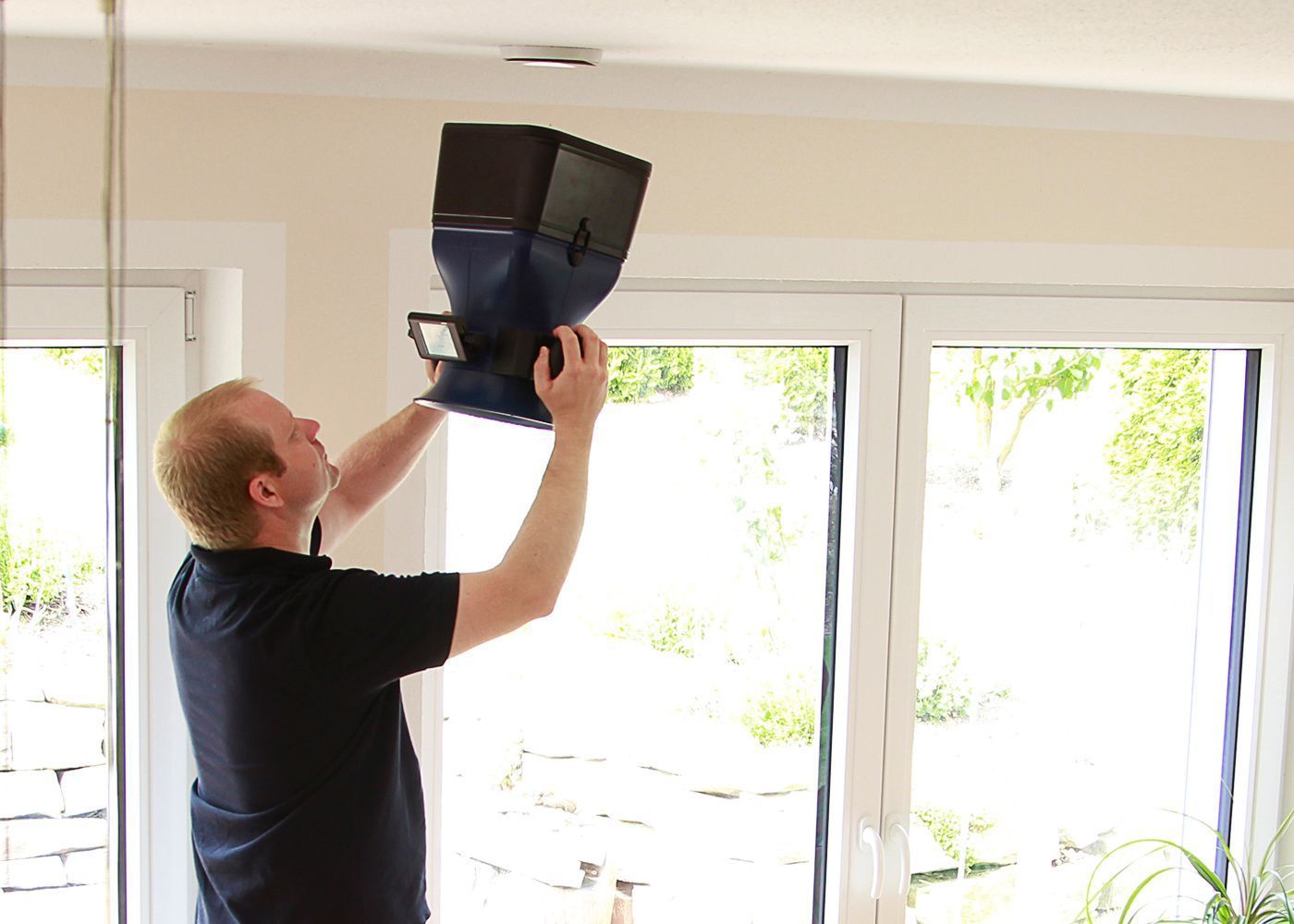























































Volume flow measurement on air outlets (funnel measurement)
Other topics from this section:In order to ensure good indoor air quality, sufficient air volume flows in accordance with the design and planning data of the ventilation system are particularly important. Therefore a regular measurement and control (flow measurement) is necessary. There are different measuring methods for volume flow measurement of ventilation systems at air outlets. Frequently used methods are loop measurement, differential pressure measurement and funnel measurement. Which flow measurement method is used to determine the volume flow of air diffusers depends on the installation situation and the shape and accessibility of the air outlets.
The following measuring instruments can be used together with a measuring funnel for funnel measurement:
- Pitot tubes:
Flow pressure and back pressure are determined, from which the velocity and volume can be calculated. - Hot-wire anemometer as a spot probe (also known as a thermal anemometer) or as an surface probe:
The cooling-down of the hot wire is equivalent to the air velocity. From this the volume is then calculated. - Impeller anemometer:
The number of rotations of the impeller allows to draw conclusions about the velocity and thus the volume.
When performing a funnel measurement at the air diffuser, special attention must be paid to the fact that when measuring with spot probes (thermoanemometers, pitot tubes), the exact positioning of the probe in the center of the measuring funnel has a great influence on the measuring accuracy. These measuring elements depend on a homogeneous (laminar) flow profile. Depending on the air flow and the funnel geometry, this does not always occur. For this reason, measuring elements which measure over the entire cross-section of the funnel (hot-wire anemometer as flat probe, impeller anemometer with attached measuring funnel) offer a more exact measuring result than spot probes.
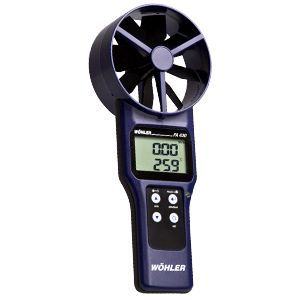
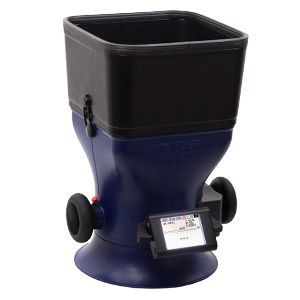
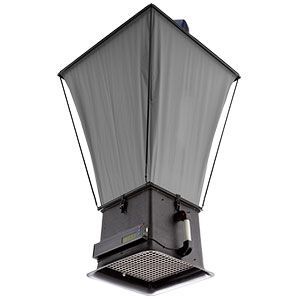
Another advantage of an impeller anemometer is that loop measurements can also be made without a measuring funnel. Good impeller anemometers also automatically recognize whether a measuring funnel has been attached or not and can immediately provide the exact measurement results, since the correction factors of the funnels are already stored in the measuring device. This saves the user valuable time on site.
PERFORMING OF VOLUME FLOW MEASUREMENT ON AIR OUTLETS
During the funnel measurement, a measuring hood is positioned tightly on the air outlet so that the entire volume flow passes through this hood. The measuring element is usually placed in the funnel or the measuring hood at the position of the smallest cross section. According to the continuity equation, the volume flow (V) depends on the area (of the measuring funnel) (A) and the flow velocity (v) [V=A*v]. Since the surface area of the measuring funnel is known and the measuring elements determine the air velocity, the volume flow is displayed in m/s or m3/h directly on the measuring device. These results can then be compared with the construction data of the ventilation system in order to evaluate the corresponding volume flows. If the volume flows at the air diffuser do not correspond to the design and installation data, the setting of the ventilation system should be optimized and, if necessary, a total volume flow measurement should be carried out at the central ventilation unit.
In order to make a statement about the air quality, it is useful to measure temperature, relative humidity and, if necessary, the CO2 content of the incoming or outflowing air and the CO2 content of the room air simultaneously with the funnel measurement. This can be done easily and quickly with a suitable impeller anemometer.