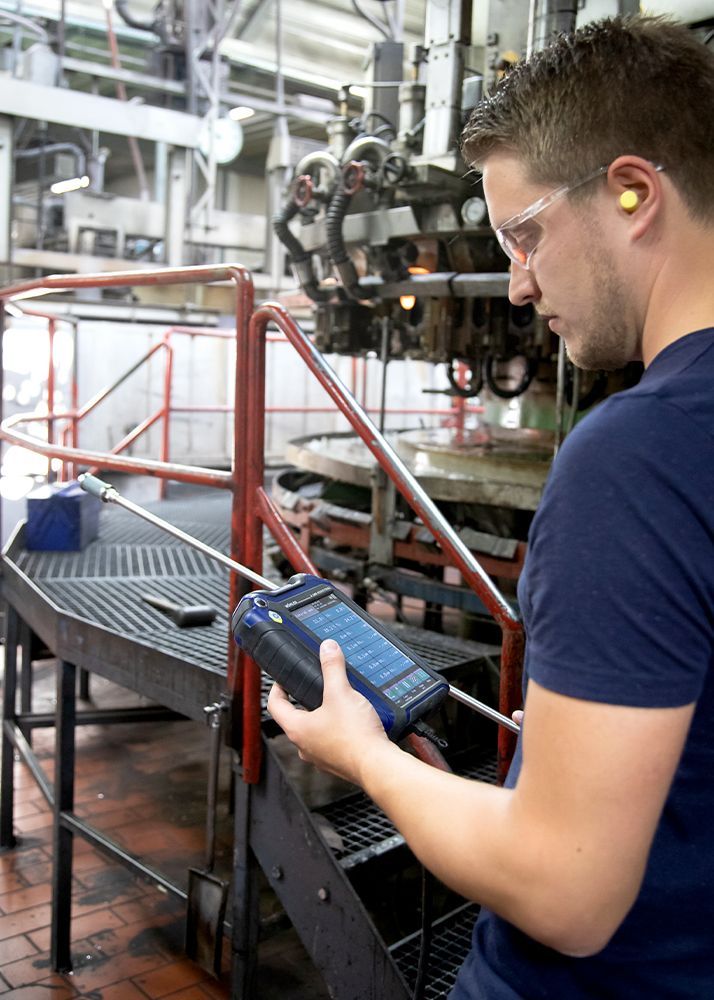























































Industrial flue gas analysis
Other topics from this section:Industrial flue gas analysis is a legal requirement in many countries, but it also makes sense to analyze flue gases without an official obligation to measure. The list of advantages ranges from cost savings to emission reductions to ensuring production quality.
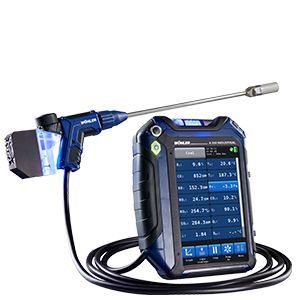
Discover the Features of the Wöhler A 550 Industrial Flue Gas Analyzer. You can find more information on our website.
Industrial combustion processes can be found in a wide range of industries, such as power generation or the chemical industry. Industrial combustors are also used in waste incineration or cement production, where they are a major cost factor that needs to be reduced to a minimum. In addition, compliance with environmental standards is playing an increasingly important role.
In industrial flue gas analysis, a variety of gases are involved, including
- Oxygen (O2)
- Carbon monoxide (CO)
- Carbon dioxide (CO2)
- Nitrogen monoxide (NO)
- Nitrogen dioxide (NO2)
- Sulphur dioxide (SO2)
- hydrogen sulfide (H2S)
- Particles (dust, soot)
Some of these substances can pose a direct threat to the health of people and nature, so a clean combustion process should be a priority. This can only be achieved by regular control of the combustion process.
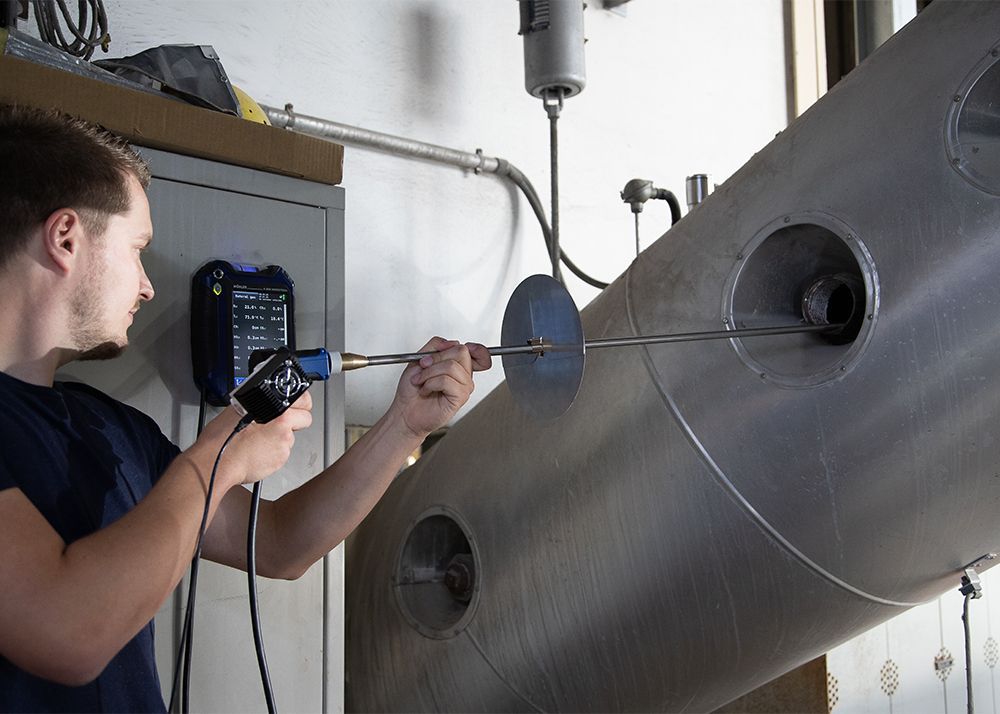
As an example of an industrial combustion process, the production of cement can be mentioned. Until the 1960s, cement plants were considered to be dirt skidders, and to this day they still produce four times as much CO2 as all the air traffic on the planet. If the cement industry were to be considered as one country, it would be the third largest CO2 emitter in the world, after China and the United States.
Through more modern filter systems, further development of rotary kilns and the use of SNCR (selective non-catalytic reduction) processes, emissions of dust particles, SO2, CO2 and NOx have been reduced, but emission limits should and must continue to be strictly controlled.
The raw materials for cement are mainly natural and are ground and mixed in a dry process. This is followed by the burning process in rotary kilns, after which the cement is cooled and ground again. A typical rotary kiln thus produces 3,000 to 10,000 tons of cement clinker per day.
This manufacturing process is a good illustration of where it makes sense to monitor the combustion process.
Examples of measuring points are:
- Measurement in the kiln, in which the carbon dioxide bound in the limestone is released in order to optimize the combustion process and create a balance sheet
- Measurement before the electrostatic filter to determine the efficiency of the plant and to create a balance sheet
- Measurement of the flue gas in the stack to check compliance with the emission limit values
Only regular monitoring of compliance with emission limits can ensure that emissions of substances harmful to the climate and health are minimized. At the same time, cost savings can be achieved by optimizing the combustion process. The fuel energy required for the production of clinker depends on the raw materials used and amounts to approx. 3200 - 5500 Megajoule per ton in Europe. This corresponds to up to 1500 kWh of energy per ton of clinker. Thus, an optimization of the combustion process which leads to 1% less energy demand would directly correspond to a saving of 15 kWh energy per ton of clinker. For a production of 10,000 tons of cement clinker per day, this corresponds to a saving potential of almost 55 million kWh energy per year.
It is therefore easy to see why industrial flue gas analysis plays an important role both for meeting environmental protection targets and for direct cost savings.