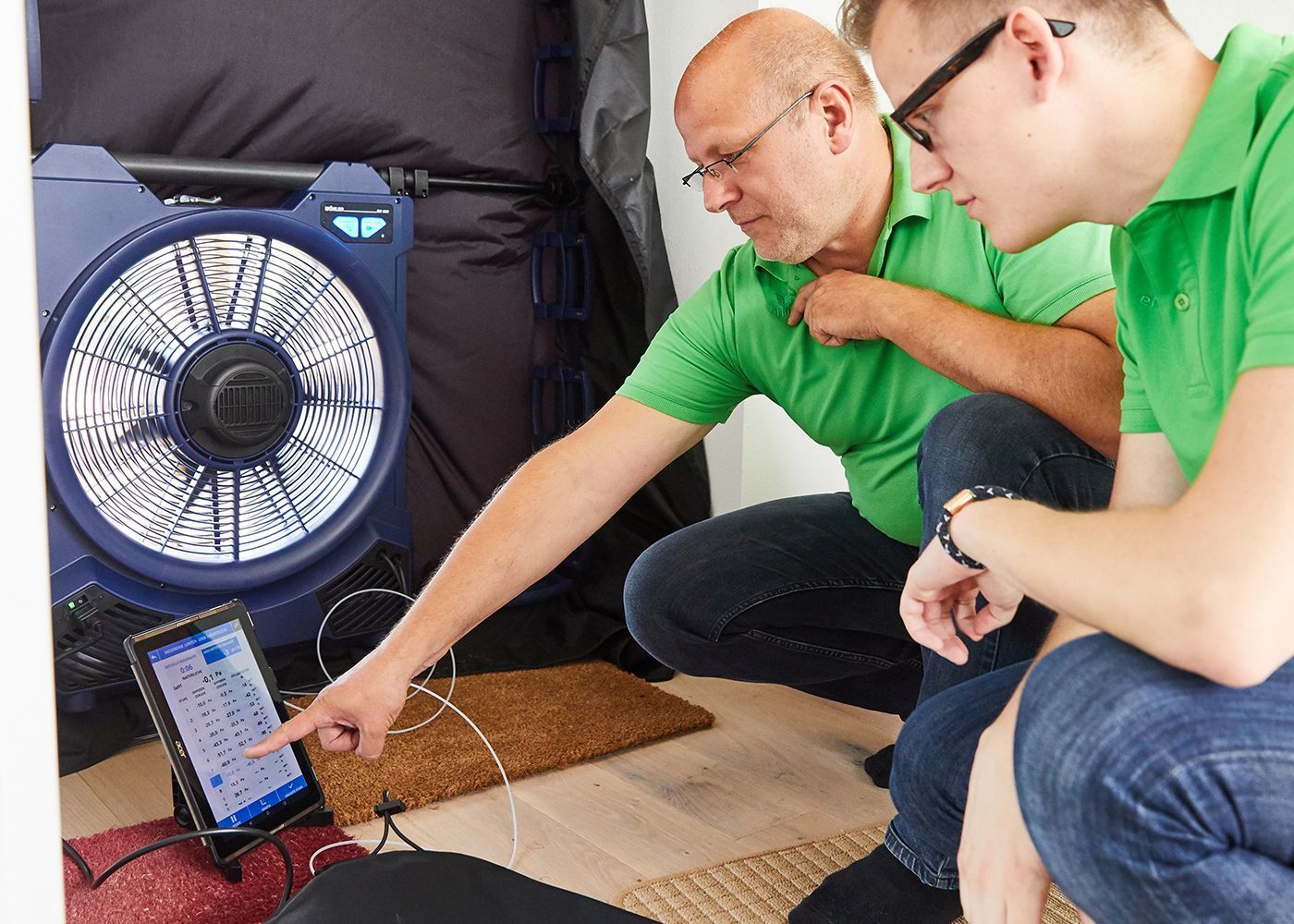























































Blower-door-test - measuring the airtightness of a building
Other topics from this section:An airtight building envelope prevents condensation or structural damage and heat loss through uncontrolled ventilation. In addition, compliance with the air tightness limit values is a requirement for cost savings. This can be determined by the Blower Door measurement (air tightness measurement).
The Blower Door measurement is a pressure difference measurement in which the influence of the wind at wind force 5 on a building is simulated. This corresponds approximately to the conditions on a stormy autumn day. The air exchange rate is determined and leaks in the building envelope are documented.
The measuring methods are described in EN 13829 and EN ISO 9972 and differ in the building preparation:
The building envelope is tested to prove that it meets the country-specific requirements. All openings to the outside are sealed (e.g. cat flaps, window rebate ventilators, exhaust air openings, fume extraction system,... etc.).
For example in order to prove the requirements according to the German GEG (Building-Energy-Law), the building is checked in its state of use. Here, openings that can be closed are closed, but not additionally sealed. All other openings in the building envelope remain unchanged.
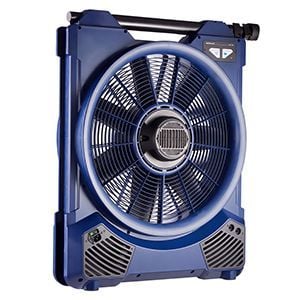
With the Wöhler BC 600 Blower Door measuring device, the fully automatic measuring procedure according to EN ISO 9972 or EN 13829 in the entire volume flow range from 15 m³/h to 6000 m³/h is done in no time at all without changing the measuring orifice.
The Blower Door measurement has the following advantages:
It shows significant savings potential and impending energy loss. The measurement can contribute to savings in heating costs and higher living comfort, because draughts through the building envelope reduce the level of comfort. Weak points in the building envelope are revealed. Blower door measurements during construction can prevent serious structural damage in advance.
How is a blower-door-test carried out?
Procedure of a Blower Door measurement
To determine the air exchange rate, all windows and outer doors are closed during the blower door measurement. The inner doors to all heated, cooled, mechanically ventilated and ventilated rooms remain open to create a zone with a coherent air flow. From this zone the volume has to be determined. It is also possible to divide large buildings (e.g. apartment buildings) into several measuring zones.
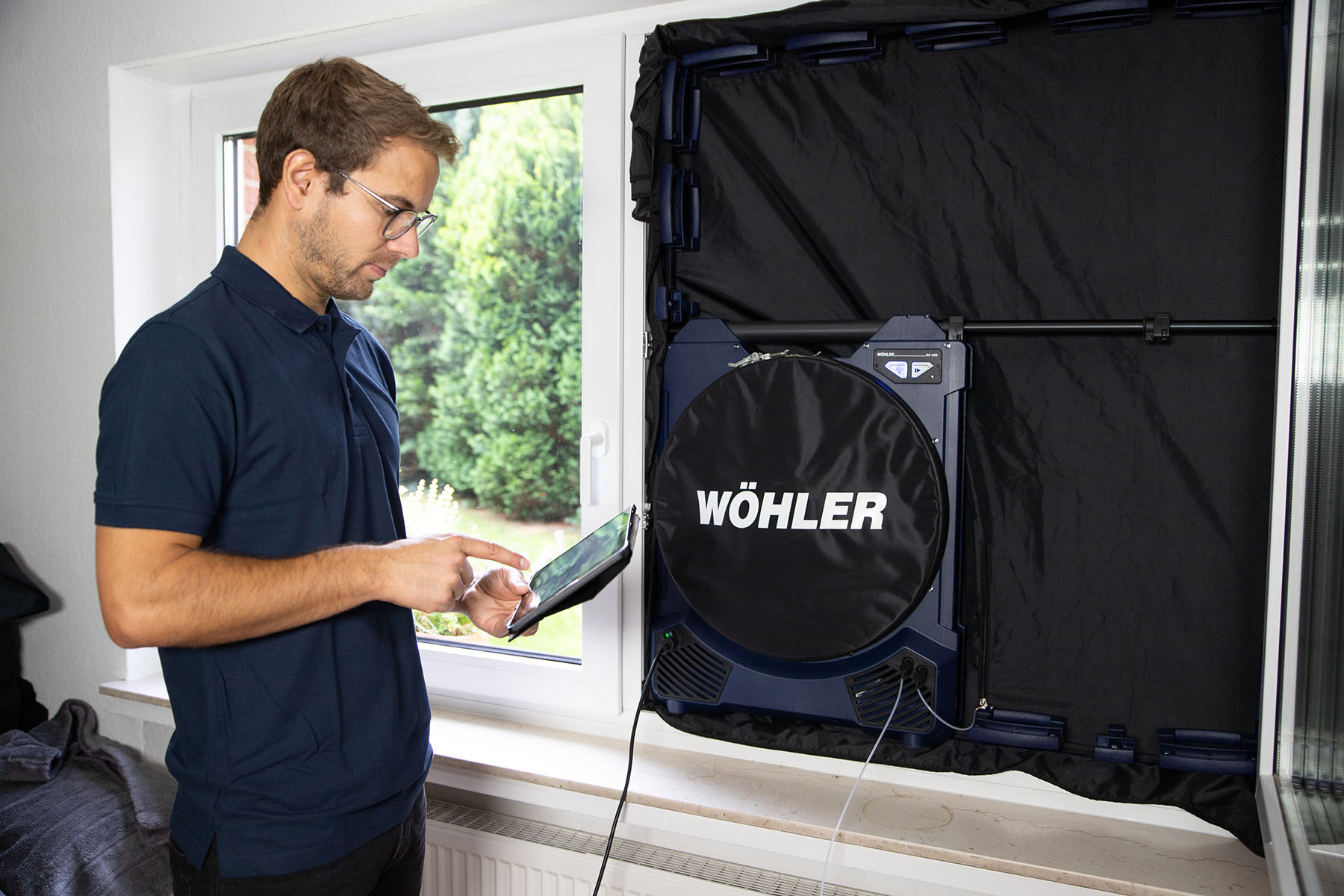
The Wöhler BC 600 consists of a fan with an airtight sealing canvas. The measuring system is inserted tightly into a window or door opening using the Wöhler clamp system.
After the building has been prepared according to the standards, the first step is the preliminary test which serves to determine large leaks. All large leaks must be documented. In addition, the measurement contractor must check whether his temporary seals can withstand the highest test pressure intended for the measurement.
In the next step, the natural pressure difference is first determined for a period of 30 seconds with the measuring device's fan sealed. Depending on the natural pressure difference, the pressure stages that have to be approached are determined. According to EN 13829 and EN ISO 9972, these are at least 5 measuring points. One of them must be at least 50 Pa. The smallest pressure difference is always 10 Pascal or five times the value of the determined natural pressure difference, whichever is higher.
Then the negative or positive pressure measurements are carried out to determine the air exchange rate. When measuring according to EN 13829, it is sufficient to perform only one series of measurements in negative or positive pressure. When measuring according to EN ISO 9972 method 3, both the negative pressure measurement and the positive pressure measurement must always be carried out.
When measuring negative pressure with the Wöhler BC 600, air is automatically extracted from the building in at least 5 different pressure levels from 10 to 50 Pascal, for example. In the case of overpressure measurement, air is blown into the building fully automatically in at least 5 different pressure levels from 10 to 50 Pascal, for example. For each pressure level, the volume flow rate is automatically calculated which is necessary to maintain the corresponding test pressure.
Finally, the natural pressure difference at the end of the measurement is determined again. Under no circumstances may the natural pressure difference exceed 5 Pascal both before and after the measurement. This requirement is defined in both EN 13829 and EN ISO 9972.
Finally, the Wöhler BC 600 App calculates a density and temperature corrected mean volume flow at 50 Pascal from the measured data. This volume flow is then divided by the inner volume of the measuring zone. The result is the air exchange rate. This describes how often the inner volume of the measuring zone is exchanged per hour when a differential pressure of 50 Pa is applied.
The results are then automatically transferred into a detailed standard-compliant measurement report using the Wöhler BC 600 APP.